Open-source AI 11
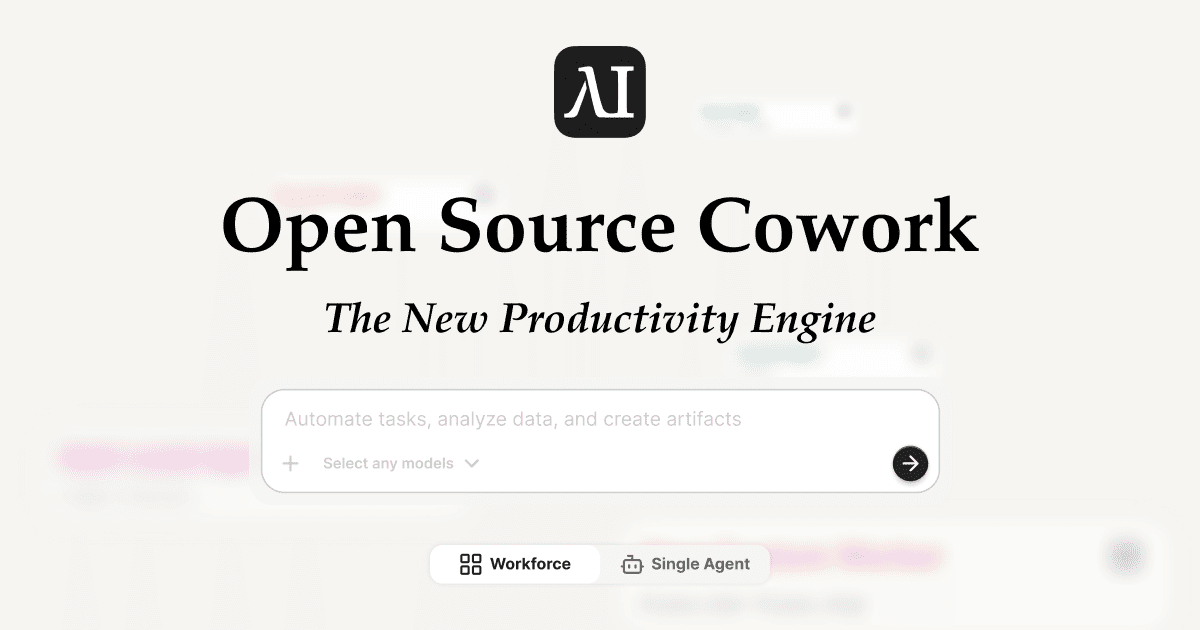
Open-source desktop AI workforce for automating browser, app, and file-based tasks.
Eigent AI is an open-source desktop multi-agent workforce that connects to users' context and automates real work across browsers, desktop applications, files, and other environments. Users can work with a single agent or coordinate specialized agents for research, writing, data analysis, browser automation, file processing, and multi-step workflows. Eigent supports local-first execution, scheduled automations, context connectors, multiple AI models, and self-hosting with personal API keys or local models.

Uncensored AI app store with private and secure access to various AI models.
FreedomGPT is an uncensored AI app store providing access to various AI models. It emphasizes privacy, security, and accessibility across different platforms. The platform includes the Liberty model, which answers questions without censorship. Users can access and vote on AI responses to personalize the system and select the best AI for their needs.

Open-source, offline ChatGPT alternative prioritizing privacy and customization.
Jan is an open-source ChatGPT alternative that runs 100% offline on your computer. It utilizes open-source AI models, prioritizes privacy, and is highly customizable. Jan is available for Windows, Mac, and Linux, with a mobile version coming soon. It provides an OpenAI-equivalent API server and allows for local server and API usage.

Open-source AI tool for real-time face swaps and avatar creation for VTubers and streamers.
DeepLiveCam is an open-source, privacy-first AI tool designed for VTubers, creators, and streamers. It offers real-time face swaps and avatar creation without requiring coding knowledge. The application allows users to morph their face into any person in real-time for streaming, live shows, and video face swaps. It works offline, doesn't collect data, and is fully local, ensuring privacy and uninterrupted use.

Platform for creating, discovering, and chatting with virtual AI characters.
Charstar is a platform where users can create, discover, and chat with virtual AI characters. It leverages the latest advancements in open-source AI to provide an unfiltered virtual character experience. Users can explore various characters, including NSFW options, and engage in conversations with them.
Shared GPU infrastructure and community for running open AI models through an OpenAI-compatible API.
NaN is a paid community and shared GPU inference platform for builders who want to run open AI models without managing their own infrastructure. It provides an OpenAI-compatible API, shared dedicated GPUs, EU-based processing, zero prompt and response logging, and access to language, embedding, reranking, text-to-speech, and speech-to-text models. Members can use the shared inference cluster, participate in a private Discord community, attend events, and vote on future models. The platform also offers a premium GLM 5.2 tier with published token allowances.

Deepseek's unified multimodal AI model for understanding and generating images and text.
Janus Pro AI is a unified multimodal understanding and generation model developed by Deepseek. It is an advanced version of Janus, incorporating an optimized training strategy, expanded training data, and scaling to a larger model size. Janus Pro AI excels in both multimodal understanding and text-to-image instruction-following capabilities, while also enhancing the stability of text-to-image generation. It supports bidirectional image understanding and generation via an autoregressive framework with a unified Transformer architecture.

Open-source AI project for chat, role-play, and character creation.
PygmalionAI is an open-source AI project focused on creating large language models for chat, role-play, adventure, and more. It offers a platform for users to engage with AI characters, create their own characters/cards, and participate in open chats. The platform provides tailored chat experiences, an open platform for character creation, and unrestricted access to in-house developed and curated models.

Open-source AI platform for cloning and generating viral videos
Hypit is an open-source AI video creation platform that clones viral video formats into editable, repeatable workflows. Using AI agents, it can recreate a video's shots, pacing, dialogue, B-roll, captions, and visual effects while anchoring edits to semantic words instead of fixed timestamps. Users can start with a reference video, describe an idea to an agent, or use templates for formats such as podcasts, street interviews, dialogue, and video calls. Hypit supports BYOK, self-hosting, Claude, Codex, and other compatible agents, with video generation powered by models including Seedance 2.0.

Launchpad for AI startups using tokenization and DAOs to democratize AI development.
Bitlauncher is a pioneering launchpad designed to redefine innovation for open-source AI startups. It addresses funding and organizational challenges through tokenization and DAOs, aiming to democratize and decentralize AI development and ownership. The platform facilitates fundraising, token sales, and community governance for AI and Web3 projects.

House of Zoox offers Morphic, a free AI search engine, and Lumo AI, an open-source answer engine.
House of Zoox is redefining search with Morphic, a free AI-powered engine that brings insights, images, and information to your fingertips effortlessly. It also mentions Lumo AI, a fully open-source AI-powered answer engine with a generative UI.