Local-first AI 9

Open-source browser AI components for private, offline applications
LocalMode UI is an open-source, MIT-licensed toolkit and shadcn-style registry for building privacy-first AI interfaces that run entirely in the browser. It provides more than 100 copy-owned React components and 36 installable blocks for chat, RAG, vector search, vision, audio, agents, privacy, and developer tools. Models run locally through WebGPU or a WebAssembly fallback, so applications can work without servers or API keys and keep user data on the device.

Open-source personal AI agent workstation with private memory and multi-channel access
QwenPaw, formerly known as CoPaw, is an open-source personal AI agent workstation developed by Alibaba's AgentScope team. It uses a local-first architecture so users retain ownership of their data, while supporting both local and cloud deployment. QwenPaw includes the ReMe self-evolving memory system, connects to more than 10 communication channels such as DingTalk, Feishu, QQ, Discord, Telegram, and WeChat, and allows one instance to host multiple agents with independent memories. Its Skills and MCP extensions support tool use, agent collaboration, and memory management.
Private on-device live captions and meeting transcription for Mac
NotchLive is a privacy-focused live captioning and speech workspace for Mac. It captures system audio, microphone audio, or both, then transcribes speech locally using Whisper AI. The app provides live captions for Zoom, Google Meet, Microsoft Teams, videos, podcasts, lectures, calls, and other Mac apps without meeting bots or cloud uploads. It also supports dictation, translated captions, session recording, speaker-aware meeting records, participant review, Meeting Analytics, Meeting Intelligence, voice notes, transcript exports, and optional local MCP connections for AI tools. Captions and speech recognition run on the Mac after the required models and language packs are downloaded.

Local-first personal AGI for coding, automation, multimodal creation, and agent orchestration
EvoForge is a local-first personal AGI desktop application for Windows and macOS. It uses an original agent kernel built in Rust to coordinate tools, context, memory, approvals, sandboxing, orchestration, browser automation, desktop control, shell access, model providers, and specialist agents. EvoForge supports frontier-level coding, document processing, image generation, voice, music, video, and a shared director's console for producing finished films. It includes 54 original skills, 98 native host tools, lead and swarm agent coordination, scoped memory, unattended tasks, and a mutation gate that tests and evaluates new skills or changes before promotion. Users install the application, connect a cloud or local model provider, configure access boundaries, and assign tasks while keeping sessions, memory, skills, keys, and operational history on their own computer.
Open-source desktop AI workforce for automating browser, app, and file-based tasks.
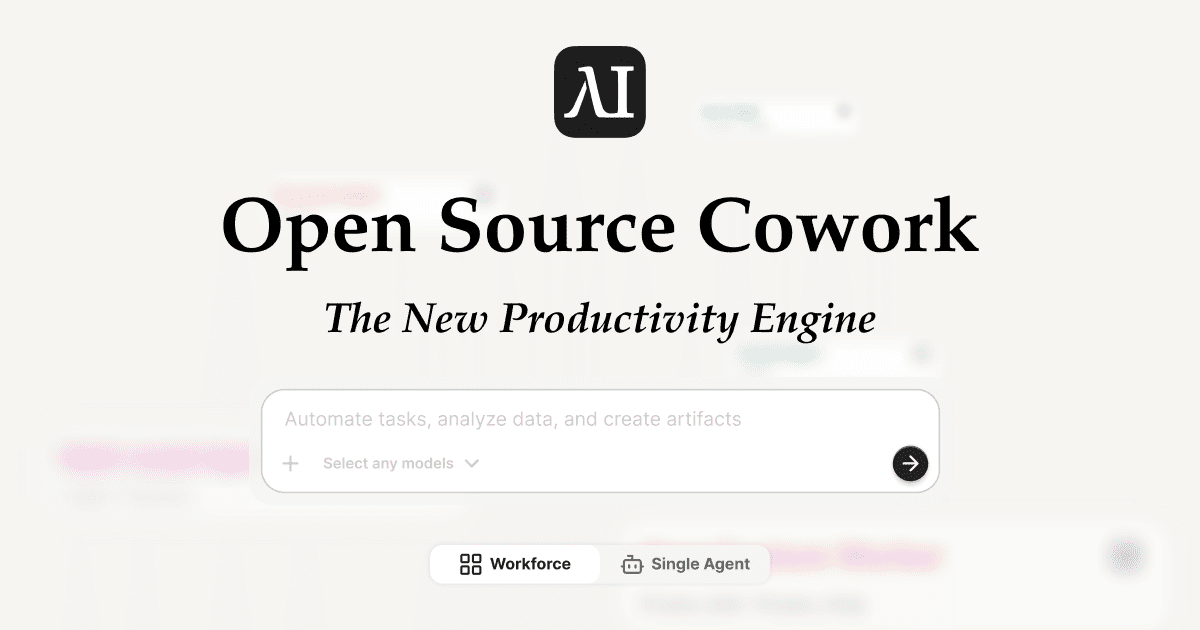
Eigent AI is an open-source desktop multi-agent workforce that connects to users' context and automates real work across browsers, desktop applications, files, and other environments. Users can work with a single agent or coordinate specialized agents for research, writing, data analysis, browser automation, file processing, and multi-step workflows. Eigent supports local-first execution, scheduled automations, context connectors, multiple AI models, and self-hosting with personal API keys or local models.
Native macOS hub for managing Claude Code and Codex CLI sessions.
AgentHub is a native macOS application designed for monitoring and managing local Claude Code and Codex CLI sessions. It acts as a local-first, unified workspace that integrates terminals, Git worktrees, diff reviews, GitHub context (PRs and issues), Model Context Protocol (MCP) apps like Excalidraw, and embedded iOS simulators with point-to-edit feedback, ensuring session data remains local and private.

Local-first shared memory and AI agent for multiple AI tools
Memmy is a local-first personal memory hub and AI agent that gives multiple AI tools, including Claude Code, Codex, Cursor, OpenClaw, and Hermes, access to shared long-term memory. It scans authorized AI conversation histories, organizes preferences, decisions, project context, and experiences into searchable local memory, and injects relevant context into future tasks. Memmy also acts as an independent agent that can organize materials, merge plans, continue unfinished work, and connect with tools, channels, and external agents through its desktop app, CLI, API, and integrations.
Local-first multi-agent workspace orchestrating specialist AI teams.
Crew44 is a local-first, multi-agent workspace that orchestrates teams of specialist AI agents to work together in parallel. Unlike generalist setups, Crew44 runs specialized roles—such as a Partner, Engineer, Product Lead, and Designer—where each agent is bound to the best-suited model for its specific task. Operating entirely on the user's local machine, the workspace allows agents to pass contexts seamlessly via short briefs, accumulate skills and long-term memory over time as plain files, and run background optimizations to continuously refine routing and capabilities based on historical run evidence.

An intelligent, local-first infinite canvas for multi-agent AI chat and deep research.
Slashspace (previously Rabbitholes AI) is an intelligent, AI-native infinite canvas designed for deep work, research, and learning. It addresses the issue of 'context collapse' in traditional single-chat interfaces by allowing users to run multiple AI models and chats as connected nodes on a single spatial board. The canvas acts as a unified context space where agents can interact and see each other's work. It supports over 1,000 tool integrations, frontier AI models, Model Context Protocol (MCP), and local-first storage, ensuring all user data stays offline and private on their computer.